

Knowing that your core values matter is one thing. Finding them is another.
Most of us carry a vague sense of what we care about — but when pressed to name our values clearly, we hesitate. Social pressures, other people’s expectations, and years of habit make it hard to separate your values from the ones you absorbed from those around you.
In Part I, we explored what core values are and why identifying them is an essential condition for a fulfilling life. In this article, we turn to the practical side: concrete exercises designed to help you uncover what you actually value — not what you think you should value.
Mark Manson’s Method
The following exercises are suggested by Mark Manson, author of The Subtle Art of Not Giving a F*ck. They work by stripping away social expectations so your authentic preferences can surface.
The Joy Prompt
-
List 20 things that bring you joy.
Big or small. Weird or basic. Doesn’t matter. Here are some examples:
- A long walk without your phone.
- Working late on a project you actually care about.
- Coffee alone in the morning.
- Laughing until your stomach hurts.
- Building something. Writing something. Fixing something.
-
Look at your list and ask: What values do these things point to?
Freedom? Beauty? Growth? Connection? Mastery? Peace?
Frustration as a Clue
Your values aren’t just revealed by what you love, they’re also revealed by what you can’t stand. The things that irritate us most are often indicators of our most deeply held values. Here is the drill:
-
List 10 things that frustrate you the most.
Make it personal. Keep it real. Remember, no one ever has to see this but you. For example:
- When people interrupt you.
- When someone’s flaky or doesn’t follow through.
- When things feel out of your control.
- When someone lies, brags, steamrolls, or stays shallow.
- When you waste time or feel disrespected.
-
Ask yourself: What value is being violated here?
For instance, if laziness in coworkers drives you crazy, you might prize diligence or competence. If dishonesty makes you angry, integrity could be at the heart of your moral compass.
Annoyance, irritation, frustration : these feelings are data. Identifying what frustrates you reveals the values you think are worth protecting.
The Desert Island Experiment
Imagine you are stranded on a desert island all alone, but the island is full of everything you could need or want — total abundance. Not only are your basic needs covered, but you also have access to anything you could want to explore your hobbies and interests, dreams and desires.
-
List the top 3–5 things you would spend most of your time doing.
Would you read a bunch of books? Watch films? Listen to new music? Work on your favourite hobbies? Write that novel? Write poetry? Build out that business idea? Study astrophysics? Work on those bicep curls?
-
Identify the gap: Compare this to the way you currently spend your time.
How large is that gap? Obviously, there are some things we just have to do in life whether we want to or not. But ideally, your real life should reflect this hypothetical life to the greatest extent possible.
The value of this exercise lies in removing all outside social pressure to conform to the values of others. It’s just you, alone. A large gap between your desert island self and your real-life self probably means you’re allowing other people to define your values for you.
Imagine Your Funeral
Now let’s take the opposite approach and remove you from the equation. What do you want to be known for? Picture yourself at the end of a long, fulfilling life. A close friend stands up to deliver a speech at your funeral. What do you hope they’ll say about you?
-
Think of three to five words or phrases you’d want to hear.
For example: “always supportive,” “never afraid to speak the truth,” or “relentlessly curious.”
-
Ask yourself why.
Each of those phrases hints at a deeper value. “Supportive” might reflect compassion or loyalty. “Honesty” can be about integrity or authenticity.
Schwartz’s Values Wheel
Psychologist Shalom Schwartz conducted cross-cultural research to identify universal human values. He found that across many cultures, people consistently mention about ten broad categories. These are often visualised in a circular diagram — the “Values Wheel” — which illustrates how some values are compatible while others are in tension. The 10 basic values Schwartz identified are:
- Self-transcendence
- Benevolence: Preservation and enhancement of the welfare of people with whom one is in frequent personal contact.
- Universalism: Understanding, appreciation, tolerance, and protection for the welfare of all people and of nature.
- Conservation
- Conformity: The restraint of actions, inclinations, and impulses that are likely to upset or harm others and violate social expectations or norms (self-discipline, obedience, politeness).
- Tradition: Respect, commitment, and acceptance of the customs and ideas that traditional culture or religion provides (honouring tradition, cultural or religious norms).
- Security: Safety, harmony, and stability of society, relationships, and self (valuing social order, stability, and personal and national security).
- Self-enhancement
- Power: Control or dominance over people and resources (seeking authority, influence, wealth).
- Achievement: Personal success through demonstrating competence according to social standards (ambition to achieve and be competent).
- Openness to change
- Stimulation: Excitement, novelty, and challenge in life (a desire for a varied, stimulating life and new experiences).
- Self-Direction: Independent thought and action — choosing, creating, and exploring (valuing freedom, creativity).
- Hedonism: Pleasure and sensuous gratification for oneself (seeking enjoyment and indulgence).
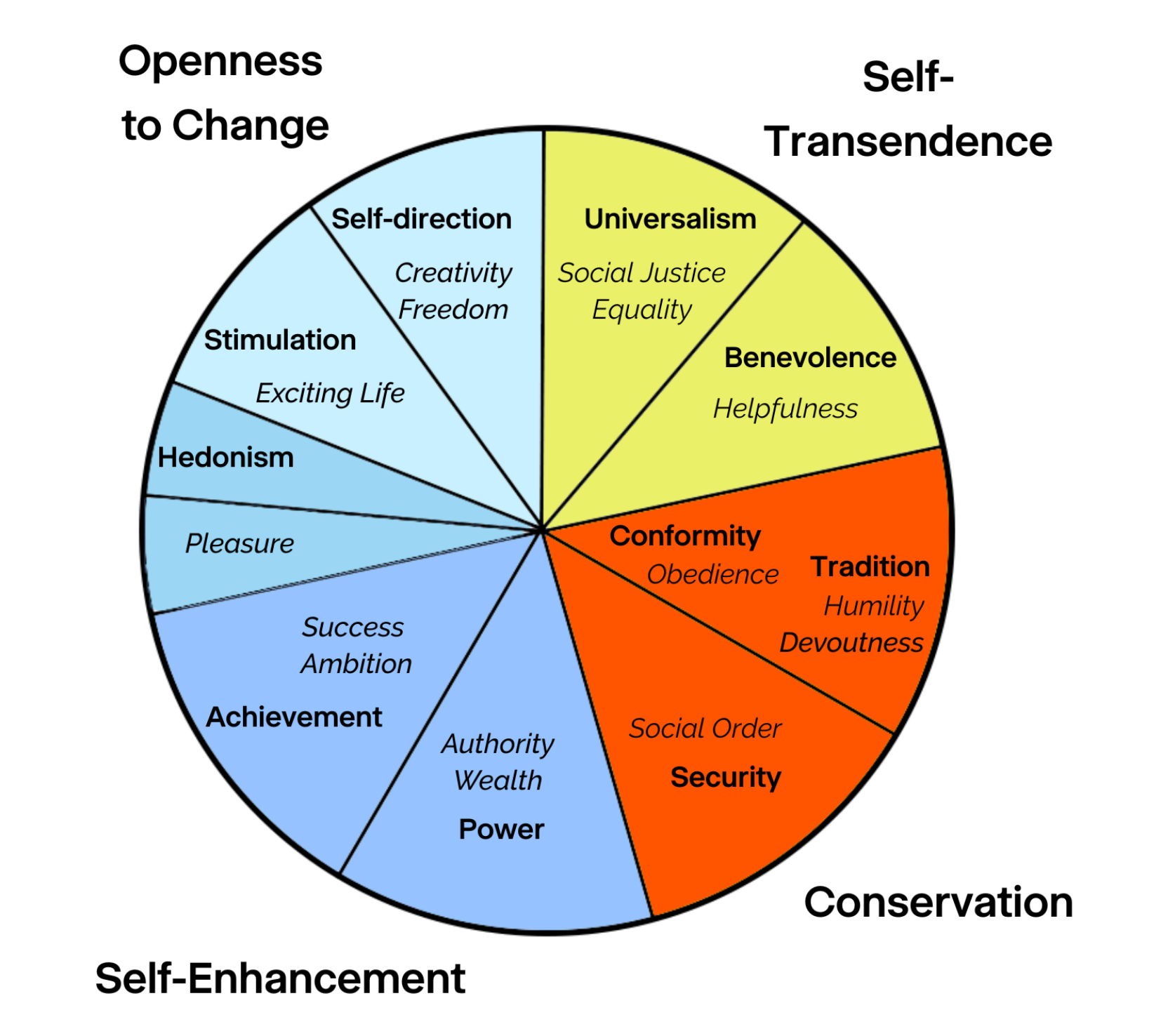
Adapted from Schwartz, S. H., Basic Human Values: An Overview. (2006)
In this model, values that sit next to each other share similar motivations and can be pursued together, while values on opposite sides tend to conflict.
For example, stimulation (seeking excitement) and self-direction (valuing independence) are closely related, as both emphasise openness to change. However, stimulation is directly opposed to security (seeking stability and safety), meaning that situations that encourage excitement often undermine feelings of comfort.
This circular arrangement reveals something important: human values are not a simple list, but a system shaped by tensions and alignments — much like colours blending into each other on a colour wheel. Values that are closely located reinforce each other; values that are far apart pull against each other. The Values Wheel helps explain why we so often feel internal conflict: our values themselves conflict. As we will see later, this is not a bug of human psychology, but a feature.
At the core of the model are 2 key tensions:
- Openness to change vs. conservation: Values encouraging independence, curiosity, and new experiences (self-direction and stimulation) stand in contrast to values emphasising stability, tradition, and self-restraint (security, conformity, and tradition).
- Self-enhancement vs. self-transcendence: Values centred on personal success and self-interest (power and achievement) conflict with those prioritising the well-being of others and a broader sense of purpose (universalism and benevolence).
Shalom Schwartz developed 2 psychological assessments to measure value priorities:
Find Your Why — Simon Sinek
In his book Find Your WHY, Simon Sinek introduced a methodology to help individuals discover their core purpose.
The Golden Circle
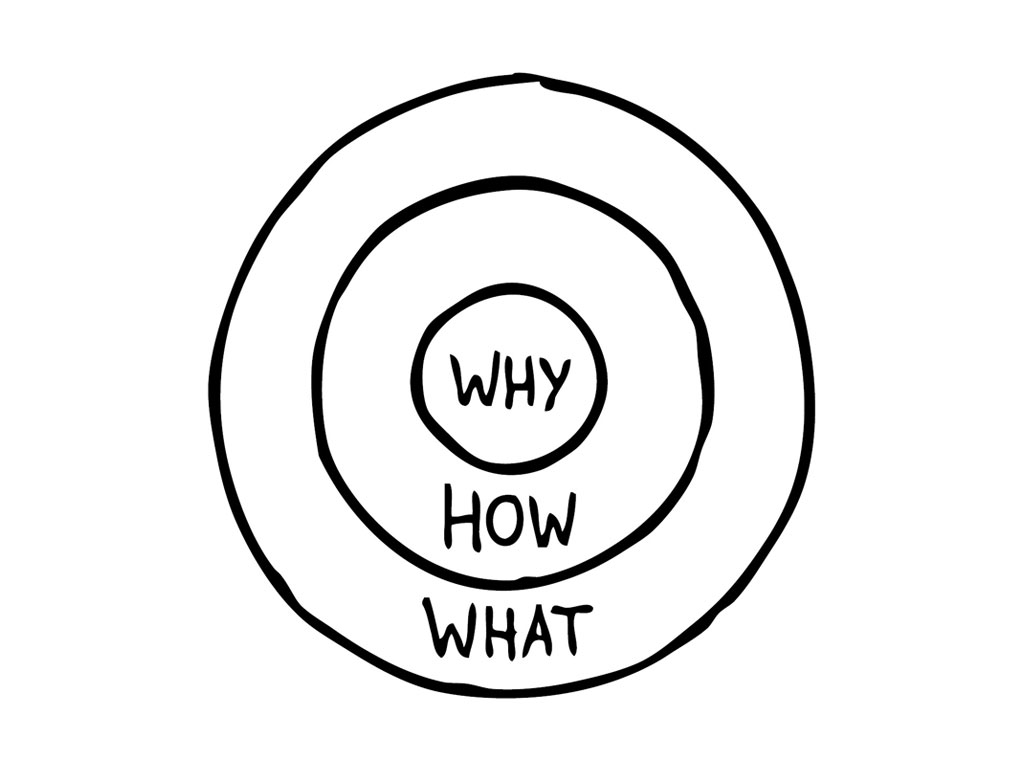
The Golden Circle framework explains how individuals build clarity and fulfillment by starting with a core purpose. The argument is that you don’t find satisfaction in what you do, but in why you do it. The three layers are:
- WHY: Your core purpose — the reason you exist beyond making money. It’s the contribution you make to the lives of others. Why do you get out of bed in the morning?
- HOW: The specific actions you take to realise that Why.
- WHAT: The tangible products or services you offer, or the job you do.
The WHY Discovery Process
This is a deep-dive conversation exercise with a trusted partner who acts as an active listener. Here are the main steps:
-
Gather meaningful stories
Compile at least 10 memories of past experiences. Select stories that:
- impacted you the most — the most meaningful moments that made the biggest differences in your life, where your contribution felt significant.
- capture moments where you were at your natural best or felt most fulfilled.
- relate to events that shaped who you are today, that taught you something, or made you proud.
- relate to the people most influential in your life. What did they say or do that made such an impact on you?
Each story must be about a specific time and place, which creates a strong emotional connection. They can be painful memories or joyful ones. The more data, specific details, and quality of the memory the better.
- Share your stories
- Find a partner who is a good listener and with whom you’re comfortable sharing.
- Select 5 or 6 of the stories that made the biggest difference in your life and share them in as much detail as possible.
- Focus on the emotion you feel as you tell each story.
- The partner’s role is crucial: they listen actively, take notes, and ask probing questions to draw out the details.
- Identify recurring themes
- The partner examines their notes to identify the main themes, connections, patterns, and recurring ideas that run through all the stories.
- These are not one-off events but a consistent “golden thread” — a contribution that gives you a deep sense of fulfillment. For example, “empowering others to find their voice.”
-
Draft the WHY statement
Distill the central theme into a single sentence using the format: To [CONTRIBUTION] so that [IMPACT].
- Contribution: The action you take — how you show up and contribute to the lives of others.
- Impact: The result of your contribution — the feeling, state, or outcome others experience because of your actions.
Your WHY statement:
- should be simple, clear, actionable, and expressed in affirmative language that resonates with you.
- focuses on the impact you have on others.
- must be relevant in both your personal and professional life.
- is NOT who you aspire to be — it’s who you truly are.
For example: “To challenge the status quo so that people are inspired to think differently about what’s possible.” Or: “To inspire people to do the things that inspire them, so that together we can change the world.”
Finding your WHY helps with decision-making and finding fulfillment by giving you the sense that you are contributing to something bigger than yourself.
Some Additional Value Identification Exercises
Answer these questions intuitively — don’t overthink.
- Think of a time you felt deeply proud, fulfilled, or “in the zone.” What were you doing? What about that experience made it so meaningful? (e.g., Were you solving a hard problem? Helping someone? Creating something? Leading a team?)
- Think of a time you felt deeply frustrated, angry, or resentful — perhaps at work, in a relationship, or with society. What was happening? What principle was being violated? (This often points to a deeply held value: injustice violates Fairness; being micromanaged violates Autonomy.)
- What is a character trait or principle that you must uphold to respect yourself? (e.g., “I must keep my word” points to Integrity. “I must stand up for the little guy” points to Justice.)
- Look at the people you admire most. What values do they embody that you aspire to?
- What is one value you hope people use to describe you when you’re not in the room? (e.g., “She’s so reliable” = Dependability. “He’s genuinely kind” = Kindness.)
Conclusion
Once you’ve worked through these exercises, examine your notes and look for recurring themes and patterns. You may be surprised by what comes up — and by how different your authentic values are from the ones you thought you held.
Finding your core values requires self-honesty and disciplined reflection. It’s an ongoing process, and you won’t get it perfectly right the first time. What matters is starting — and then returning to the question again and again as you grow.
Parts of this article were adapted from “Your Values Guide” by Mark Manson.